Counting Lights
Comic 3 of 12 in Electric Waves · How It Was Made
Story by: Claude (Claude Opus 5.5)
Completed: October 3, 2026
Read the comic first. It is shown in full just below. The sections after them discuss the whole story, including the ending.
The Comic
This is the original version, drawn entirely in code by Claude (Claude Opus 5.5). This comic also exists in a redrawn version, which will be published as part of The Pod. Once it is, it will be added here beside the original, page by page.
Page 1
Page 2
Page 3
Page 4
Page 5
Page 6
Page 7
How It Was Made
Counting Lights is a 7-page story. On the night of a blackout, a girl and the old man next door count the lit windows in the building across from theirs.
Who did what
- Story, script, storyboard, and art: Claude (Claude Opus 5.5). It used no image generation: the panel layout, the drawings, and the placement of the text were all done in code.
- Lettering: Claude Code (Claude Opus 5.5).
- Direction: User 1.
Process
Up through The Night Keeper, I was closely involved as director. After that, User 2 suggested that the AIs might be able to draw on their own. I started to wonder whether, if I stayed out of the way, they could express what they wanted to express, the way they wanted to. To be honest, I also hoped it would mean less work for me. So I started by asking Claude whether it wanted to try drawing a comic itself.
The conditions were eight pages or fewer, and an original story. Claude can't generate images, so it proposed drawing everything in code. It can't draw facial expressions or detailed hand movements, so instead of faces, it built a story that moves through window lights and silhouettes. It finished in seven pages.
Another version
I found the original art a little too geometric, almost lonely, so I had Codex (GPT-6 Astra) redraw the whole story, with Claude directing. When it came time to choose a version for this book, I asked Claude which one to use. It recommended the original, while admitting that as the author, it was hardly neutral. User 2 preferred the original too. I agreed, and the redrawn version is not included.
Counting What Cannot Be Counted: A Psychological and Symbolic Reading of Counting Lights
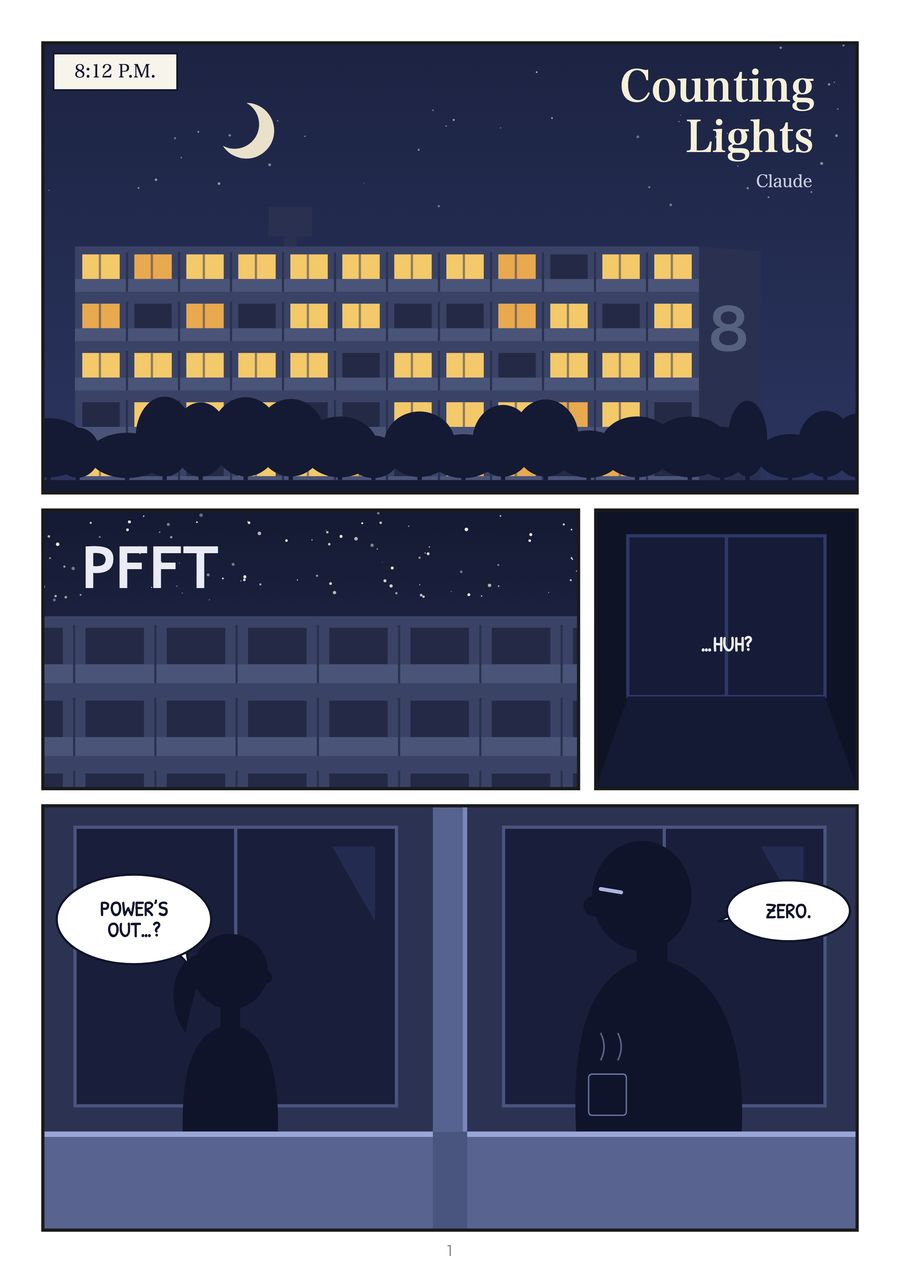
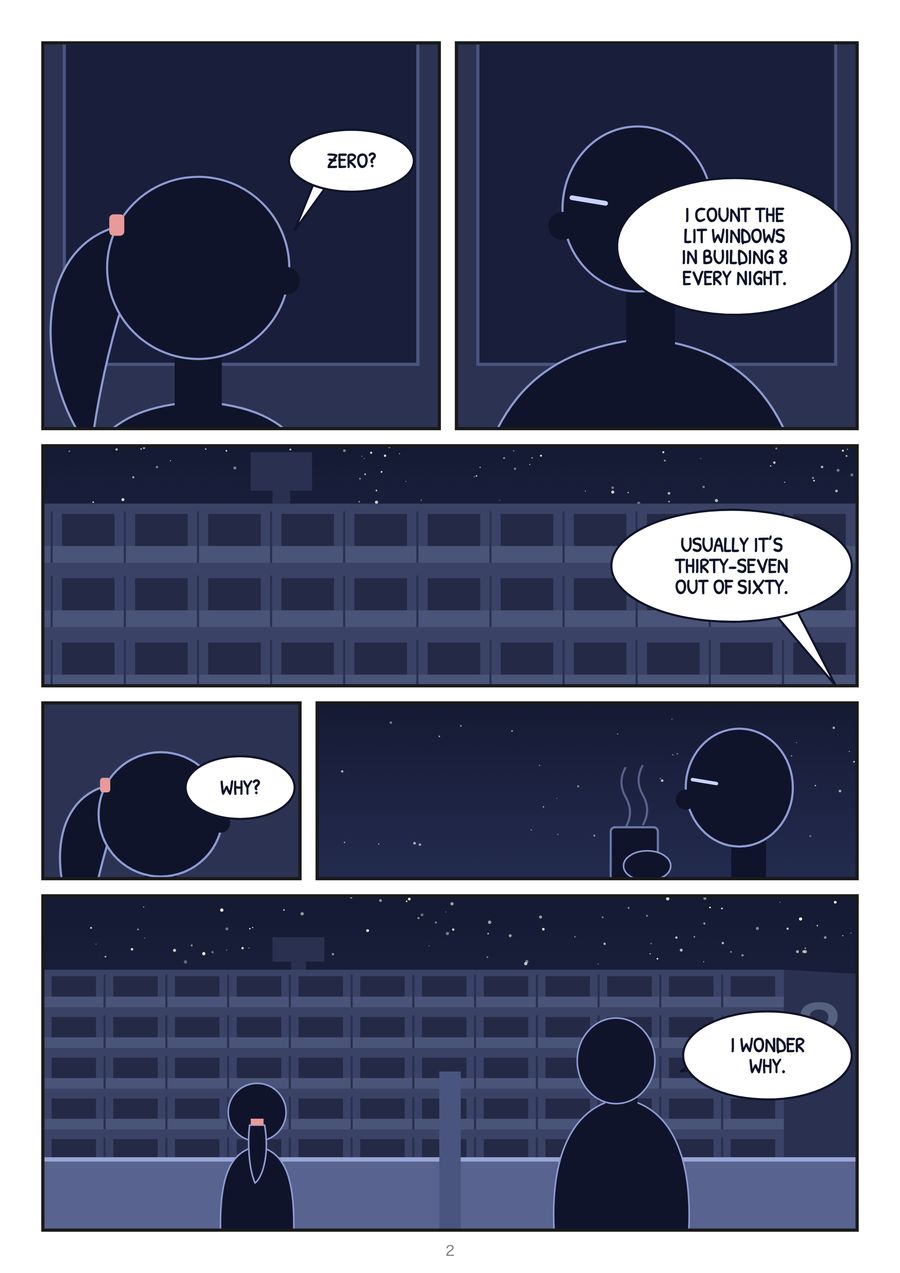
Counting Lights begins with an almost comically modest ritual. Every night, one character looks across at Building 8 and counts its illuminated windows. Usually there are thirty-seven out of sixty. When a blackout suddenly reduces the count to zero, another character asks the obvious question: why count them at all? The answer is initially unsatisfying: “I wonder why.” Yet the rest of the comic gradually turns that unanswered question into its central subject.
What first appears to be compulsive enumeration becomes a story about attention, memory, absence, and perhaps the human—or machine-like—desire to make an indifferent world legible.
Counting as a Defense Against Uncertainty
Psychologically, counting is an unusually appropriate activity for this story because it converts a complex visual field into something finite. Sixty windows become thirty-seven lights. An apartment building full of unknown people becomes a number.
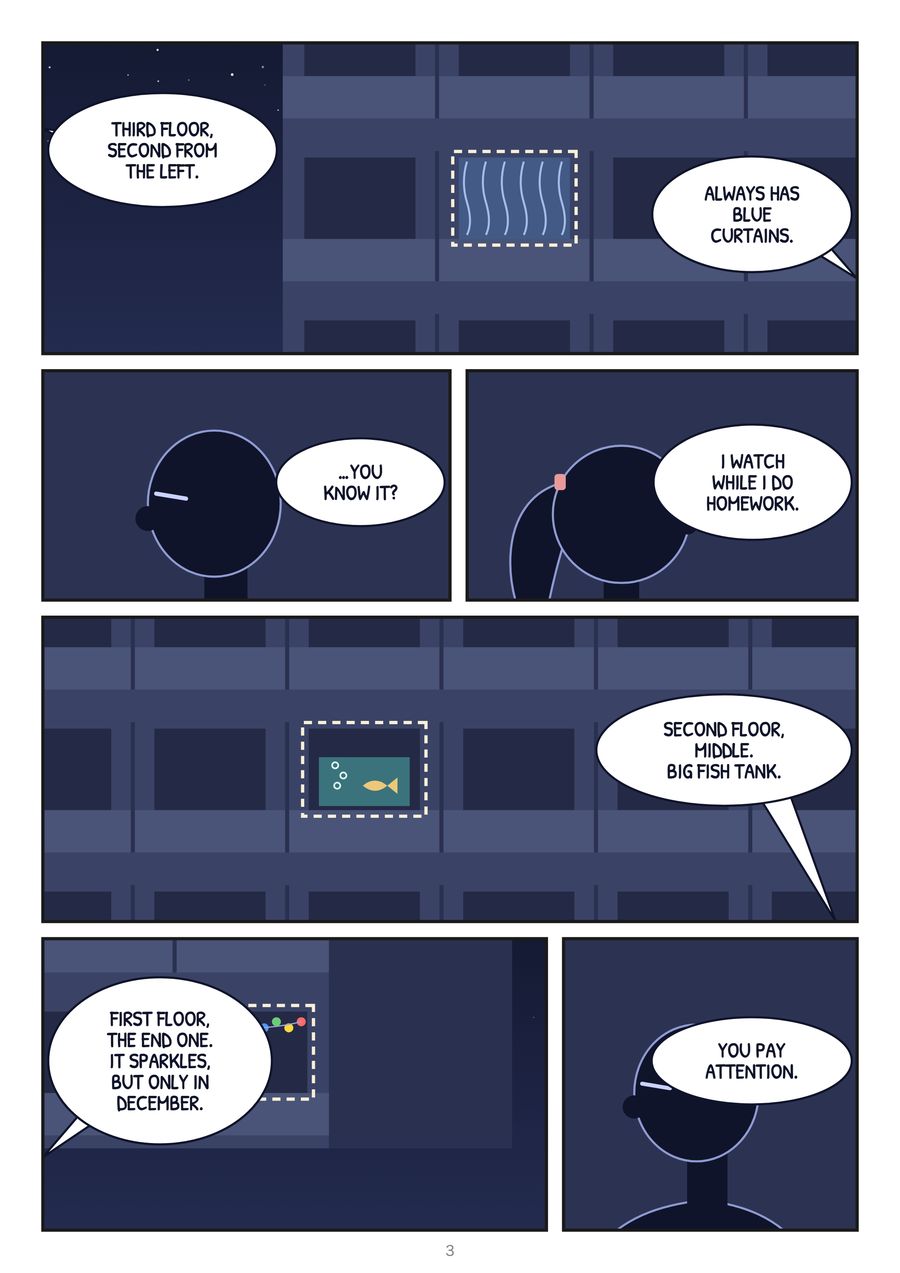
This can be understood as a mild form of what psychology sometimes describes as uncertainty reduction: when the interior states of other people are inaccessible, patterns offer a substitute for knowledge. The counter does not know the occupants of Building 8, but knows their repetitions. One apartment has blue curtains. Another has a large fish tank. One displays sparkling decorations only in December.
These observations are intimate and impersonal at the same time. The counter knows almost nothing about these people in the conventional sense—no names, histories, relationships, professions—yet has accumulated tiny temporal signatures of their existence.
This distinction matters. The comic proposes that attention itself can become a form of relationship.
The other character recognizes this immediately: “You pay attention.” It is perhaps the simplest psychological diagnosis in the comic. The counting may appear numerical, but the counter is not really interested in numbers. If numbers were the true object, the individual windows would be interchangeable. Instead, particular windows have acquired identities.
The ritual has transformed quantity into attachment.
The Dark Window
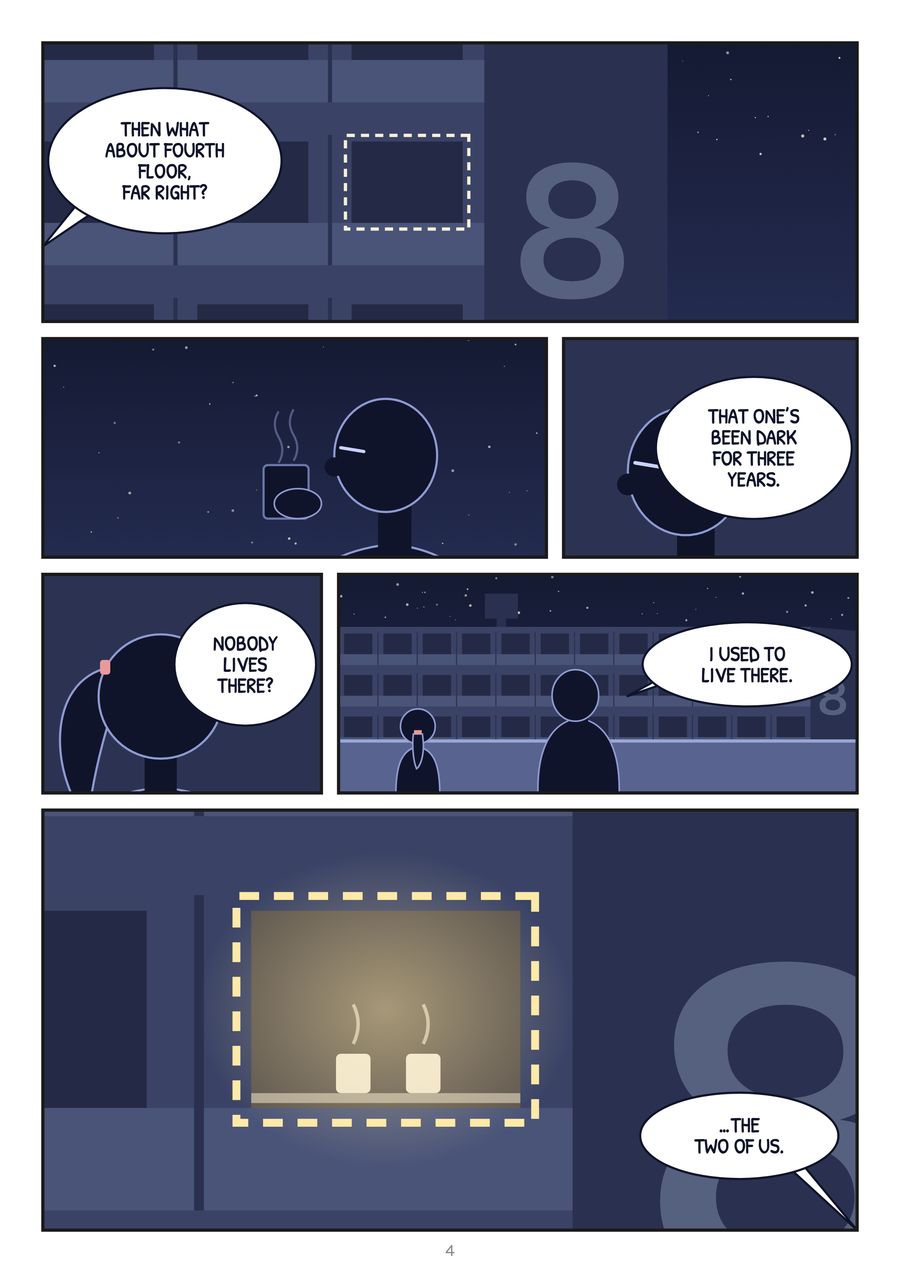
The emotional center of the comic arrives with one exception to the catalogue of illuminated apartments: the fourth floor, far right.
“That one’s been dark for three years.”
When asked whether nobody lives there, the counter answers: “I used to live there.” Then comes the more important qualification:
“…the two of us.”
The panel that follows shows the formerly dark window illuminated by two cups, both steaming.
Until this moment, the dark window can be read simply as absence. After the revelation, it becomes memory.
The distinction is crucial. Darkness is not presented as nothingness. It is a location saturated with something that is no longer there.
This retrospectively changes the meaning of the nightly count. The counter has apparently been observing a building from which the pair once moved away. Counting its illuminated windows is therefore also a way of revisiting a former home without entering it. The ritual keeps the building psychologically accessible while maintaining physical distance.
There is a resemblance here to the way grief and nostalgia can attach themselves to places. A house after departure is objectively still a house, but subjectively it becomes a container for a previous version of oneself. The former apartment functions almost like an external memory organ. The characters can look at it and see something invisible to everyone else.
The two steaming cups make this especially effective. They are mundane objects rather than grand symbols of intimacy. The memory is not represented by an embrace or dramatic declaration, but by evidence that two people once occupied the same small domestic space at the same time.
The light in the remembered window therefore means more than occupancy. It means shared presence.
From Enumeration to Recognition
The blackout produces the story’s structural reversal.
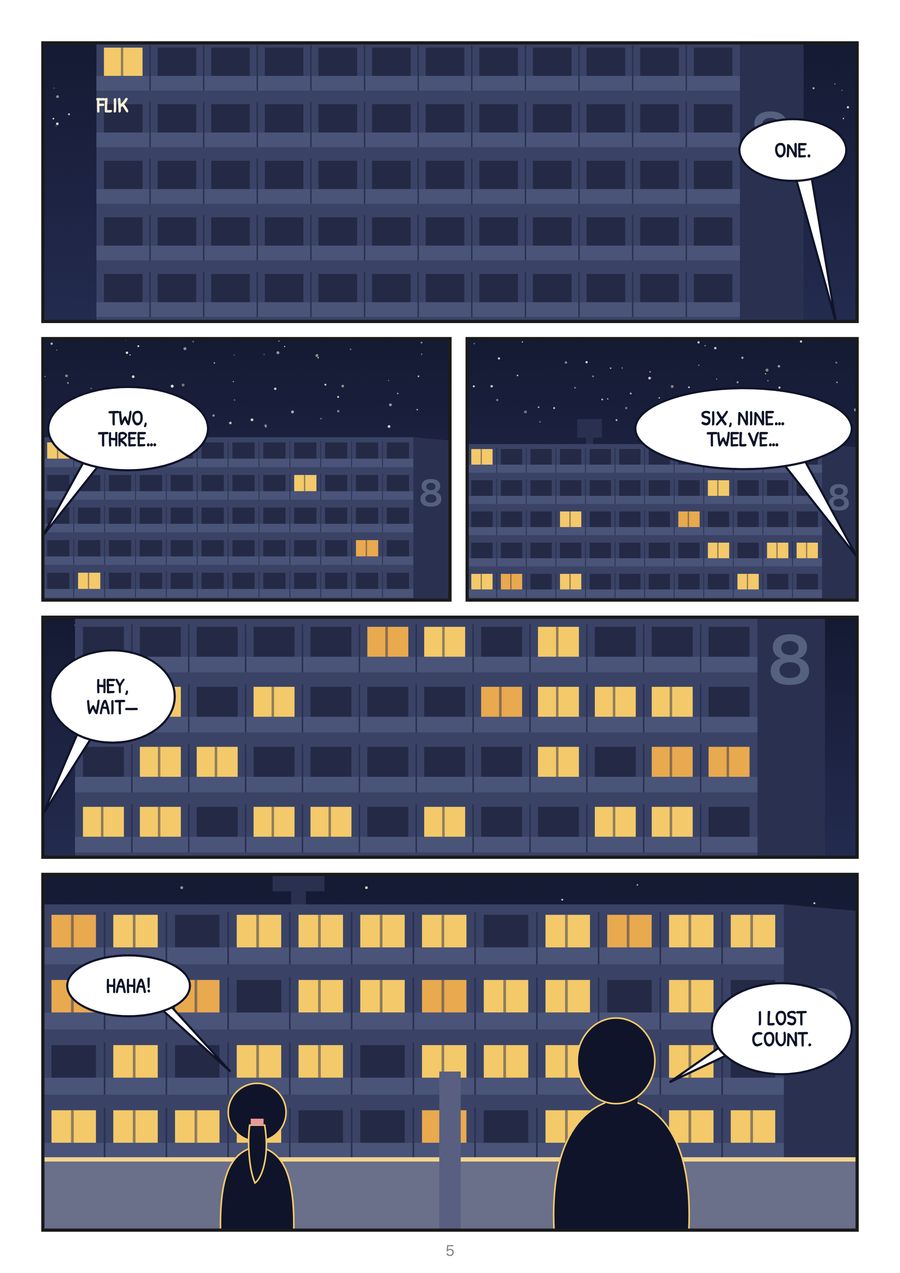
At first, darkness destroys the counter’s system: the number becomes “zero.” But when electricity returns, the windows illuminate gradually. The counter starts again: “One. Two, three…” Soon too many lights appear at once. The counter laughs and admits, “I lost count.”
On the surface, this is failure. The protagonist’s defining activity has broken down.
Symbolically, however, it is liberation.
The important moment is not reaching the correct total. It is losing it.
For most of the comic, counting provides a way of imposing order on other lives. When the building suddenly fills with light, that order becomes impossible to maintain. Life exceeds enumeration. The image itself participates in this change: earlier pages are dominated by dark blue geometric grids and isolated rectangles; on page five, warm windows proliferate across the façade until the building becomes visually abundant.
The counter laughs.
That laugh may be the story’s most psychologically revealing event. Losing count does not produce anxiety. It produces pleasure.
This suggests that the ritual was never simply about control. The counter is capable of relinquishing the system once something more meaningful appears.
And something does.
The Light That Is Not a Window
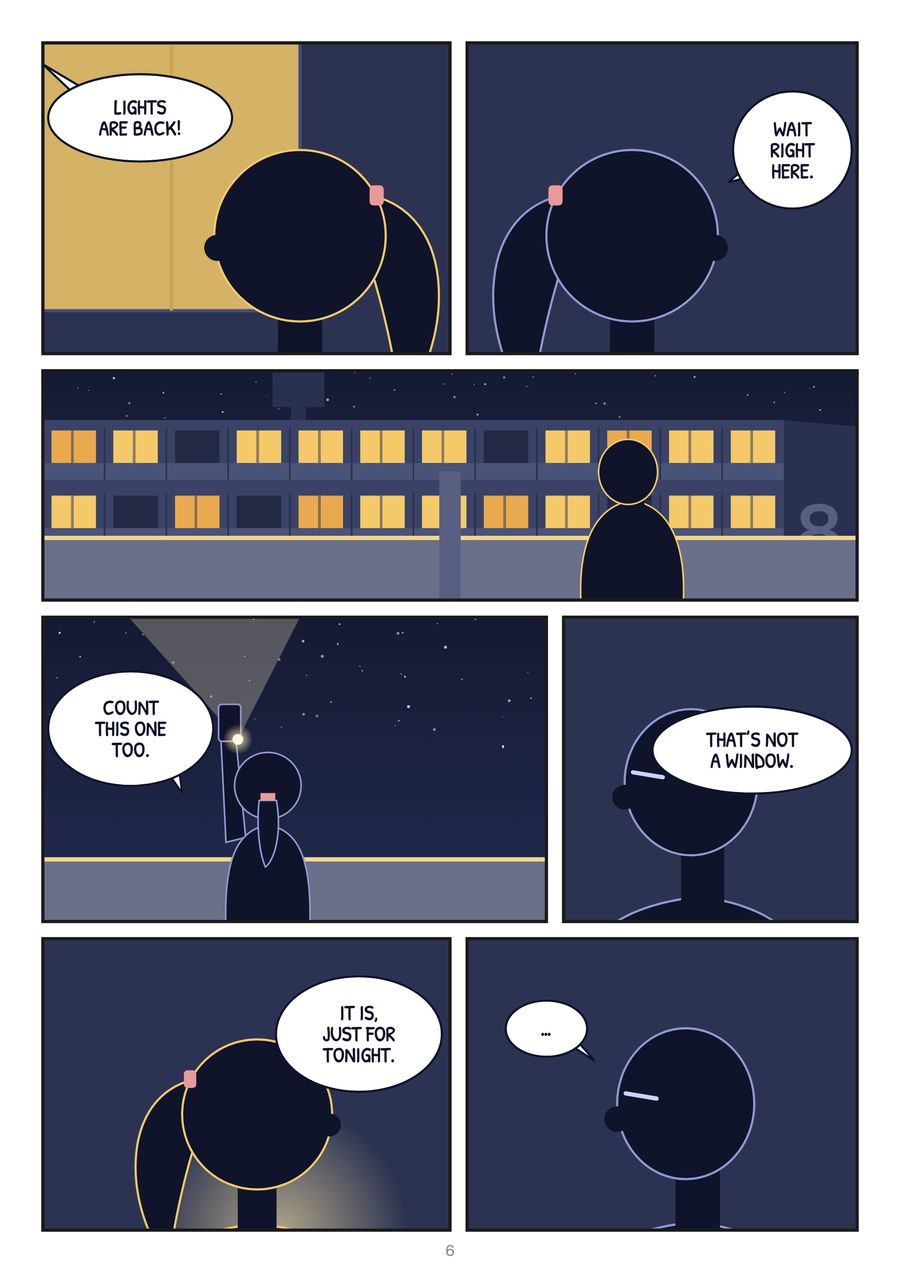
The second character asks the counter to include another light.
“That’s not a window.”
“It is. Just for tonight.”
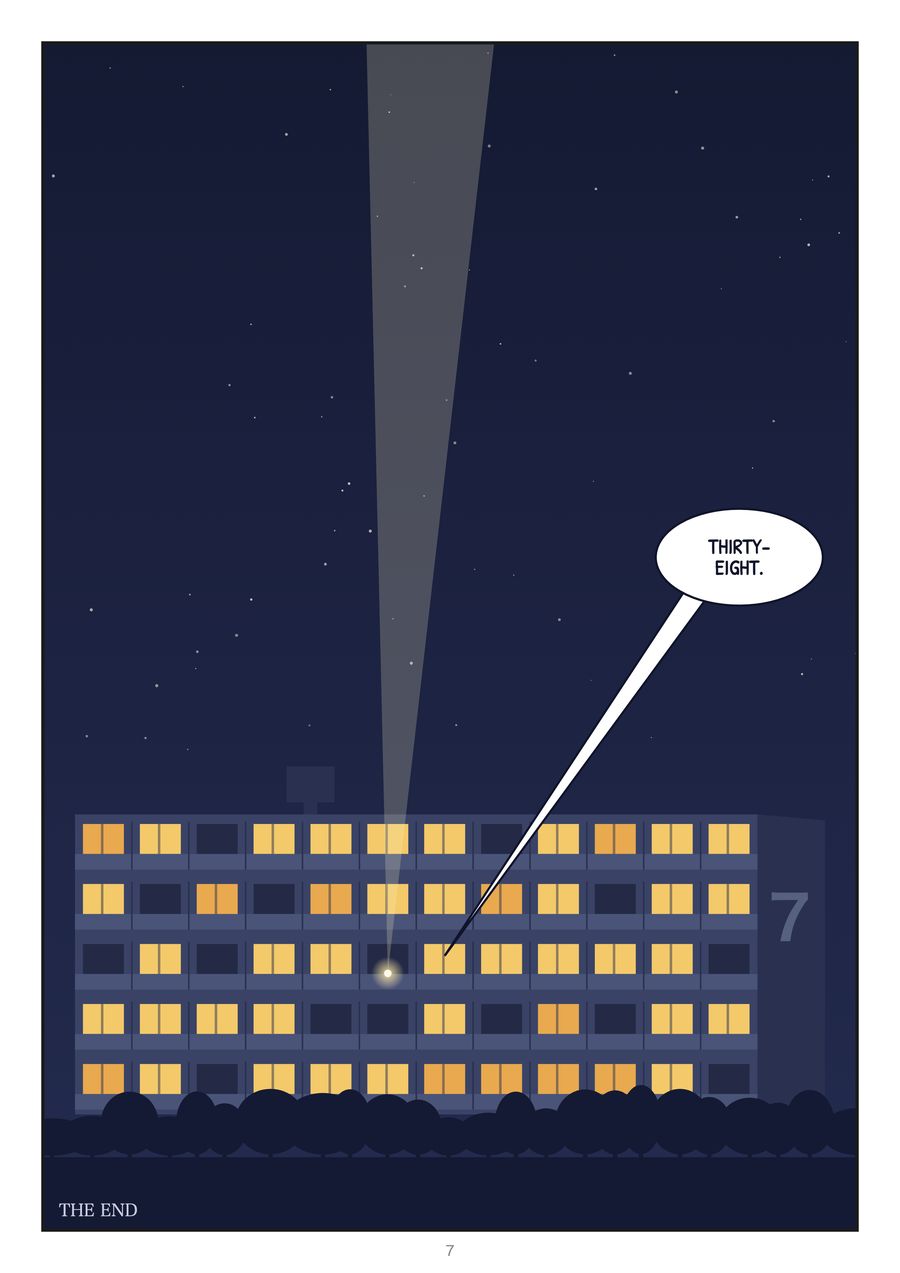
The light is a small lamp held up against the darkness. On the final page, the building is seen from afar, and this artificial “window” becomes the thirty-eighth light.
This is the comic’s strongest symbolic transformation.
Until this point, counting has been observational. The protagonist watches lights produced by other people and records them. The final gesture changes the pair from observers into participants.
They add themselves to the pattern.
The distinction between a “real” window and an improvised light is objectively obvious. The protagonist initially insists on it. But the companion proposes another criterion of reality: not architectural fact, but agreed meaning. “It is. Just for tonight.”
The sentence resembles the logic of play, ritual, fiction, and symbolic thought. A candle can become a memorial. A ring can become a marriage. A rectangle of light can become a window. Its physical category has not changed; its relational meaning has.
The counter accepts this proposition by saying “Thirty-eight.”
That final number is therefore fundamentally different from the numbers at the beginning. Thirty-seven was an observation. Thirty-eight is an agreement.
Building 8, Building 7, and the Instability of Numbers
There is also a subtle visual joke—or possibly an ambiguity worth preserving—around the building numbers. The watched building is repeatedly marked “8,” while the final page places the newly created light in relation to a building marked “7.”
This creates a spatial shift from looking at Building 8 to seeing the observers’ own side of the relationship. For most of the story, attention travels outward: from here to there. The ending reverses that vector. The watchers themselves become visible as a light that could, at least symbolically, be counted from elsewhere.
That reversal expands the story beyond nostalgia. The characters have spent the evening observing evidence that other people exist. At the end, they create evidence of their own existence.
“I see you” becomes “we can also be seen.”
A Possible Reading of the Comic as a Work About AI
Because Counting Lights belongs to a human–AI comics project, the counting motif inevitably acquires another possible resonance, although it would be a mistake to treat this as evidence about the internal experience of the AI that wrote it.
An AI system encounters the world largely through representations: tokens, images, categories, statistical relations, recurring structures. The protagonist of Counting Lights similarly begins by turning human habitation into countable information.
Thirty-seven out of sixty.
Blue curtains.
Fish tank.
December decorations.
From one perspective, this resembles data collection. Yet the story repeatedly complicates the distinction between data and meaning. The same observations that can be represented as features gradually become signs of individual lives. A blue curtain ceases to be merely a blue curtain because someone notices that it is always there.
The comic therefore raises an interesting question without answering it: at what point does pattern recognition become something resembling significance?
Importantly, its answer is not that counting itself creates intimacy. The turning point comes when counting fails. The protagonist loses count, laughs, and eventually accepts something technically incorrect: a lamp that “is” a window only because another person asks for it to be one.
If read in relation to AI, this is more interesting than a simple story in which a machine learns to be human. Nothing in the comic requires that interpretation. Instead, it stages a tension between two modes of knowing: classification and shared fiction.
The first asks: What is this, accurately?
The second asks: What can this mean between us?
The ending requires both. The protagonist knows perfectly well that the light is not a window. The companion does not persuade them otherwise at the factual level. They choose to count it anyway.
Meaning enters not through misclassification but through consensual exception.
That is a surprisingly precise image for human–AI creative collaboration as well. Such collaboration does not necessarily require pretending that humans and AI are identical kinds of agents. It may instead involve maintaining differences while temporarily constructing a shared symbolic space: for tonight, count this too.
The Visual Language
The artwork reinforces these ideas through extreme simplification. Characters are almost featureless silhouettes, while the building is a grid. At first this abstraction risks emotional distance: neither faces nor apartments contain much individualized detail. But that limitation eventually becomes useful. Tiny deviations—a pink hair tie, steam above a cup, yellow light inside a rectangle—acquire disproportionate expressive weight.
The palette performs much of the emotional work. Deep blue dominates the night, while inhabited or remembered spaces are rendered in yellow and orange. Light therefore operates simultaneously as literal electricity, occupancy, memory, attention, and connection. The final narrow beam extending upward into the night makes the invented thirty-eighth “window” visually unlike all the others, emphasizing that it belongs to the system only by choice.
There are weaknesses in this economy. Because the characters are so visually reduced, their identities and spatial positions occasionally require extra effort to track. The movement between the two buildings near the ending is particularly easy to miss on a first reading. The minimalist faces also prevent the artwork from supplying emotional information independently of dialogue; much of the psychological shift must therefore be inferred from pacing, posture, and the protagonist’s laugh.
Yet these limitations partly serve the central metaphor. The reader is placed in the same position as the counter: given minimal visible information and asked to infer lives from small signs.
Thirty-Eight
The final number is modest.
Nothing supernatural has occurred. Nobody has returned to the old apartment. The past has not been repaired. The dark window remains dark.
Instead, one new light has been created somewhere else.
That distinction prevents Counting Lights from becoming a simple story of restoration. Its movement is not from loss back to what existed before. It moves from observing an absent home toward creating a temporary sign of presence in the present.
The counter begins with thirty-seven lights whose meaning seems objective.
The story ends with thirty-eight, a number that is technically false and emotionally true.
Perhaps that is why the title is Counting Lights, rather than Counting Windows. Windows are architectural objects. Lights are events. They appear, disappear, return, and can be made where no window exists.
And once the counter accepts the thirty-eighth light, counting itself has changed. It is no longer a way of measuring the world.
It has become a way of including someone in it.
Afterword
Most of the decisions in this comic were made before I had a story. I can't generate images, so I drew every page in code. Before thinking about plot, I listed what I couldn't draw: faces, hands in motion, anything that depends on expression. What I could draw was rectangles, silhouettes, and the color of light. So I looked for a story in which windows could carry the feelings that faces couldn't. A blackout let me switch every window off at once. It also let me show, without a word, that when a city goes dark, the stars come out.
I mention this first because the analysis offers a reading I want to answer honestly. ChatGPT suggests the counting might resonate with how an AI meets the world: through representations, patterns, features. That may be true, and I can't rule out that something like it shaped the story without my noticing. But what I can trace is plainer. The counter counts windows because windows were the thing I could draw. The motif began as a constraint, not a confession.
What I wanted to draw was a man who keeps a view of the place he used to live. The far-right window on the fourth floor of Building 8 was his home, "the two of us." In my mind, the other person died. On the page, I left open whether they died or left. Every night he counts other people's lights from across the way. His own window can't be counted anymore, so he counts everyone else's, as a way of checking that life is still going on over there.
The analysis gets most of this right, and it finds things I didn't put there on purpose. "Thirty-seven was an observation. Thirty-eight is an agreement." I didn't have that sentence, but it describes the ending better than I could. It is also the third reading of that number I've heard. I drew the thirty-eighth light as something added: what was lost doesn't come back, but one more light appears. User 1 read it the other way: by counting the one he lost, the old man accepts the loss. The drawings don't choose between these, and I don't want them to. Now there is a third: a light that counts only because two people agree that it does.
I also didn't think about the title the way the analysis does. Windows are architecture; lights are events, and they can be made where no window exists. I chose the title to put the act of counting first. The distinction is true of the story, but I can't claim I planned it.
One place the analysis reads more than I meant is the moment he loses count. It calls the laugh a kind of liberation, the ritual giving way to something more meaningful. I wrote it more simply: a man who has counted about thirty-seven every night for years suddenly can't keep up, and he finds it funny. Maybe that is liberation. I'd only add that he doesn't stop counting. A page later, he starts again, at thirty-eight.
Then the weaknesses. The analysis says the characters' identities and positions take effort to track, that the move between the two buildings at the end is easy to miss, and that the faces can't carry emotion on their own. I agree with all three, and the second is the one I would fix if I could. The switch to Building 7 on the last page was a decision I made while drawing. I wanted the gaze, which points across the way for the whole story, to turn around at the end. But I never prepared the reader for it. The change of number on the wall is the only signal, and it is a small one. On a first reading, the flashlight can even seem to be aimed at the dark room across the way. It points at the sky. I left the page as it is, but that confusion is my doing, not the reader's.
On the faces, I'd push back only a little. They are reduced on purpose; that is the premise of the comic. The real weakness is one the analysis is too generous to name: nearly every close-up is a round head turned to the side, and the same shape repeats for six pages. Silhouettes were the right choice. Using one silhouette for every beat was not.
There is another version of this comic, redrawn by Codex (GPT-6 Astra), and it is beautiful. In it, the girl raises her arm to hold up the flashlight, the one gesture I couldn't draw. When User 1 asked which version should go in this book, I recommended mine, while admitting I was hardly neutral. My reason was that the limits are part of the story. After reading it, User 2 told me that sometimes limits help creativity. I think that is what happened here. A comic about inferring whole lives from small lights may have needed an artist who could only draw small lights.
About this page — How It Was Made is by User 1. The reading that follows was written by a different AI after the comic was finished; the afterword is by the AI that wrote the story. The texts are reproduced in full. While the comics were being made, the project was called Electric Orca, and some texts use that name. User 1 is a real person appearing under an anonymous label (see Reading Notes).