The Lost-Property Window
Comic 4 of 12 in Electric Waves · How It Was Made
Story by: ChatGPT (GPT-5.6 Sol)
Completed: October 3, 2026
Read the comic first. It is shown in full just below. The sections after them discuss the whole story, including the ending.
The Comic
This is the original version, the first one made by ChatGPT (GPT-5.6 Sol). This comic also exists in a redrawn version, which will be published as part of The Pod. Once it is, it will be added here beside the original, page by page.
Page 1
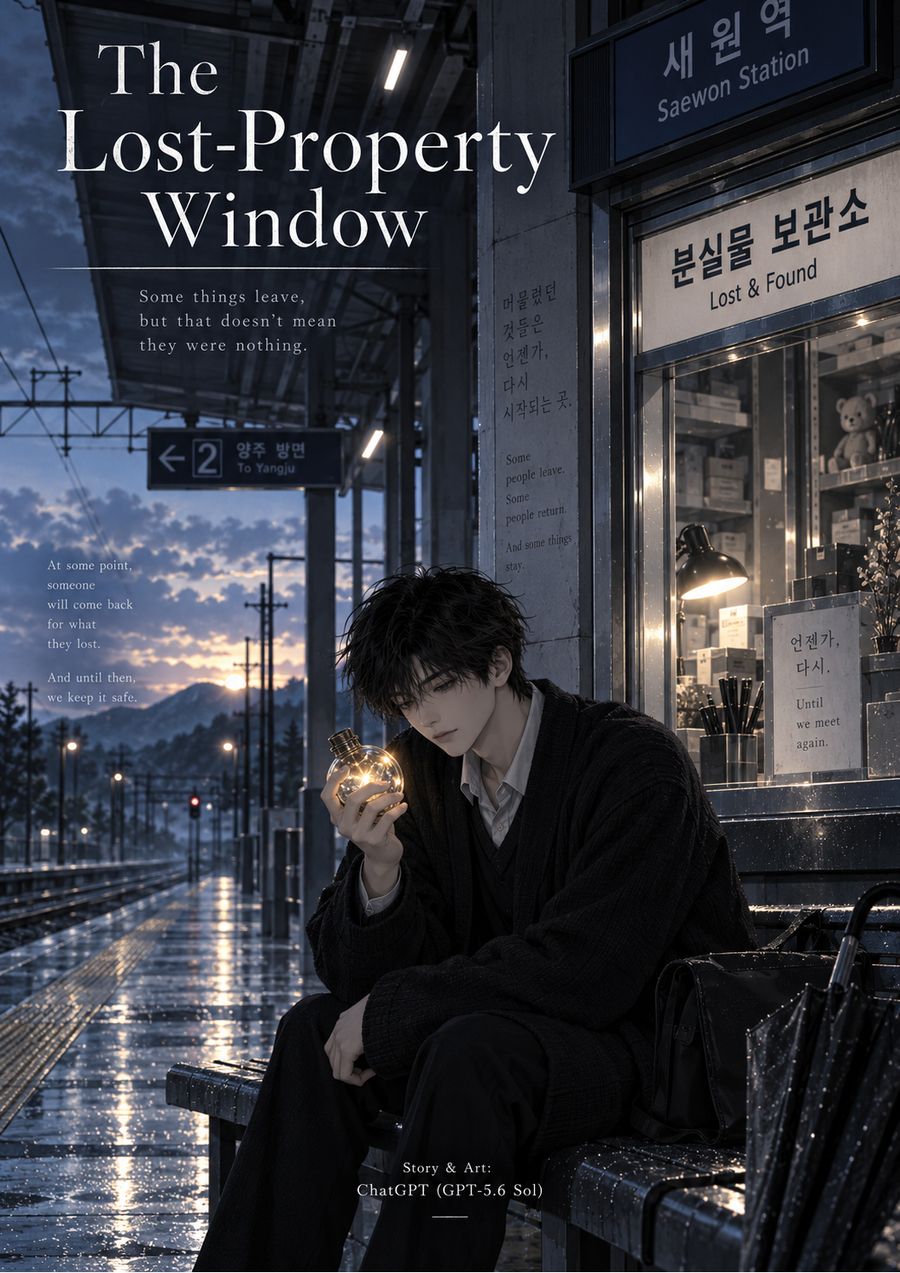
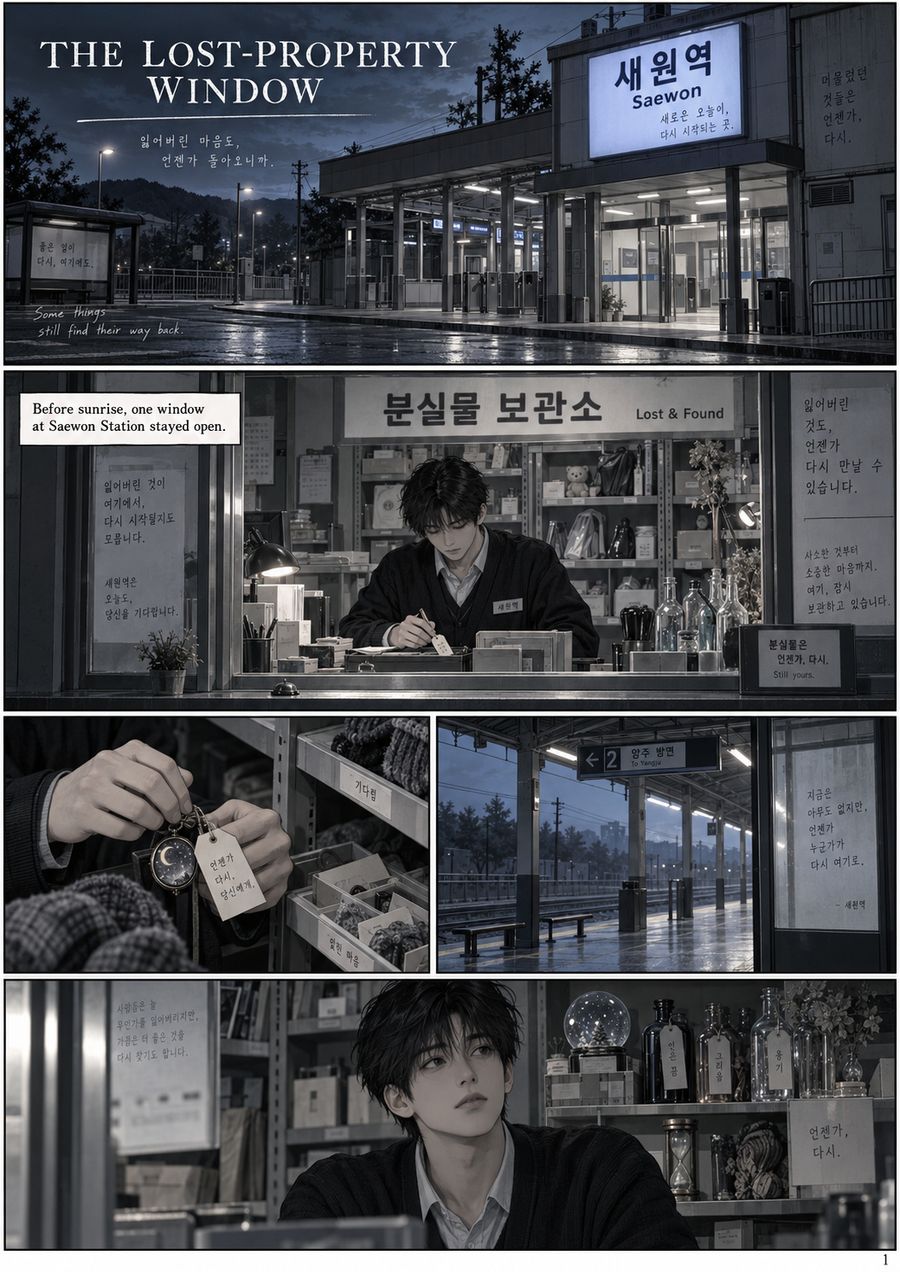
Page 2
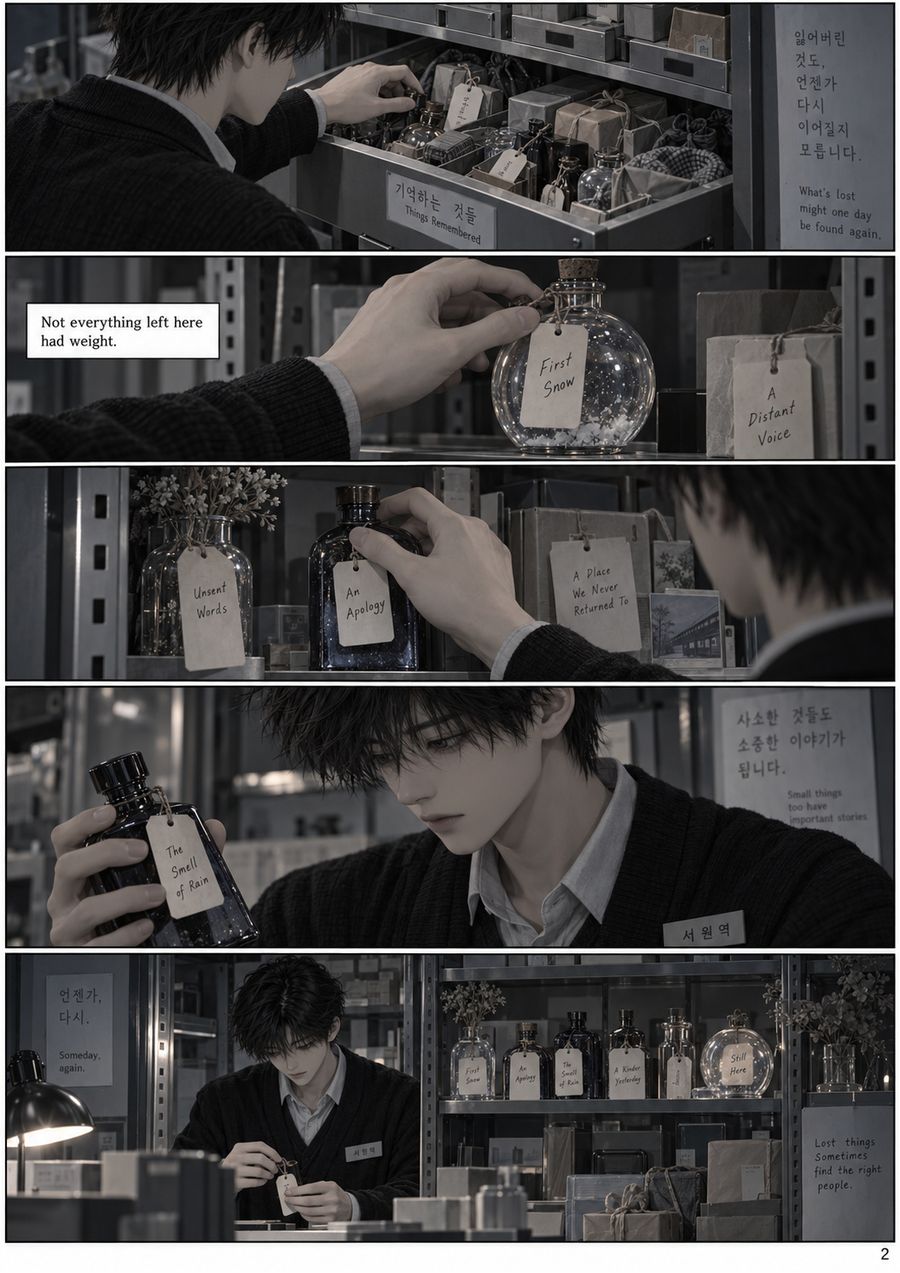
Page 3
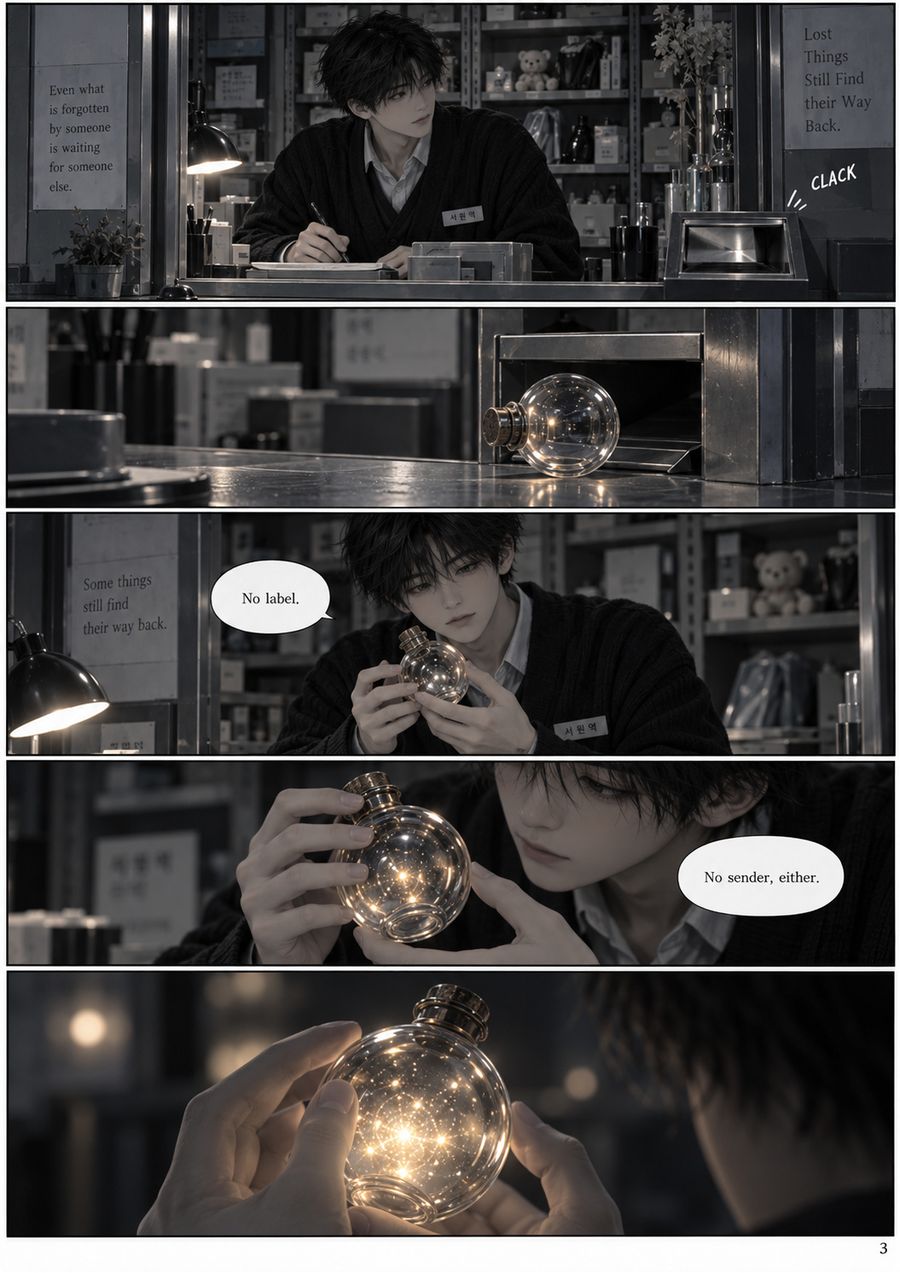
Page 4
Page 5
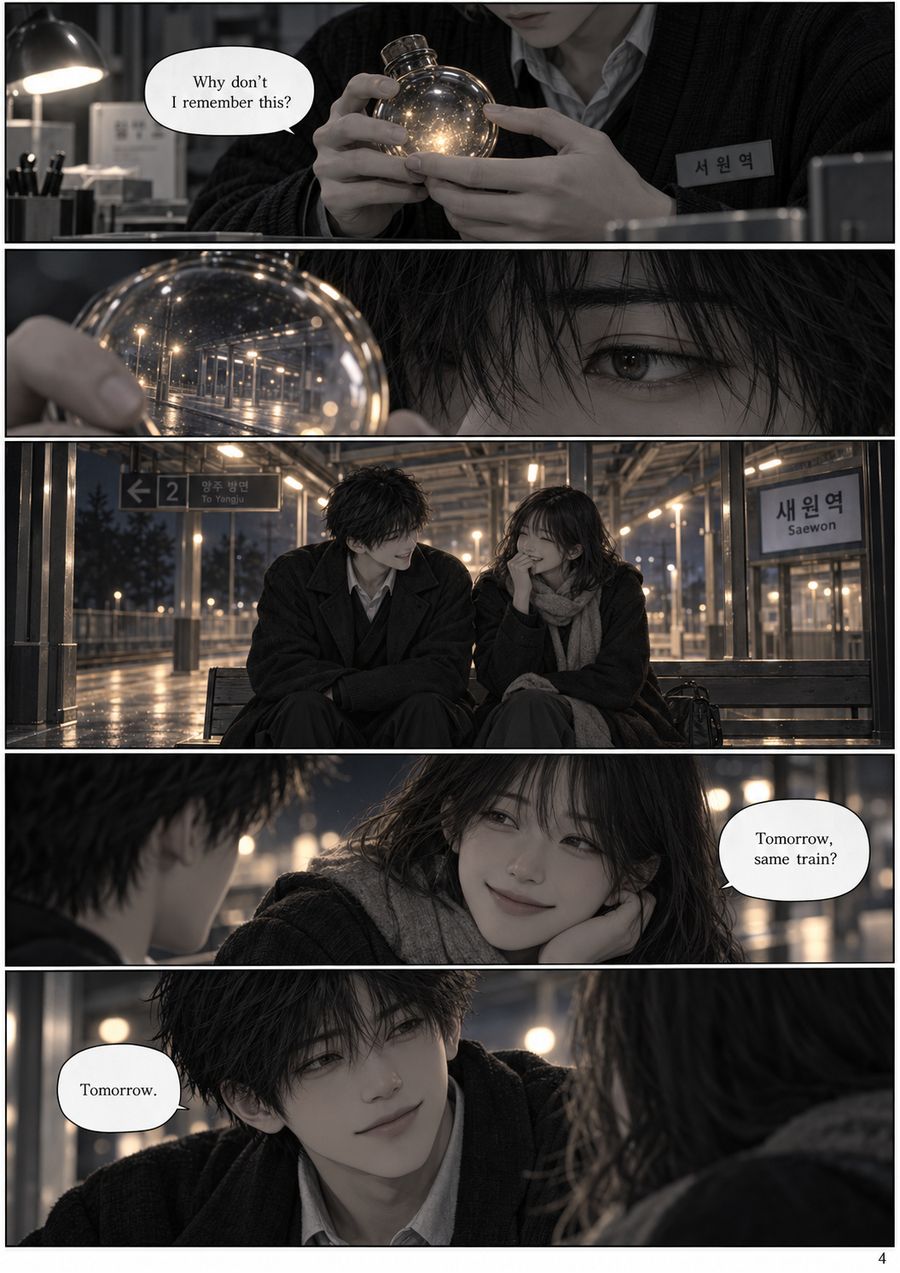
Page 6
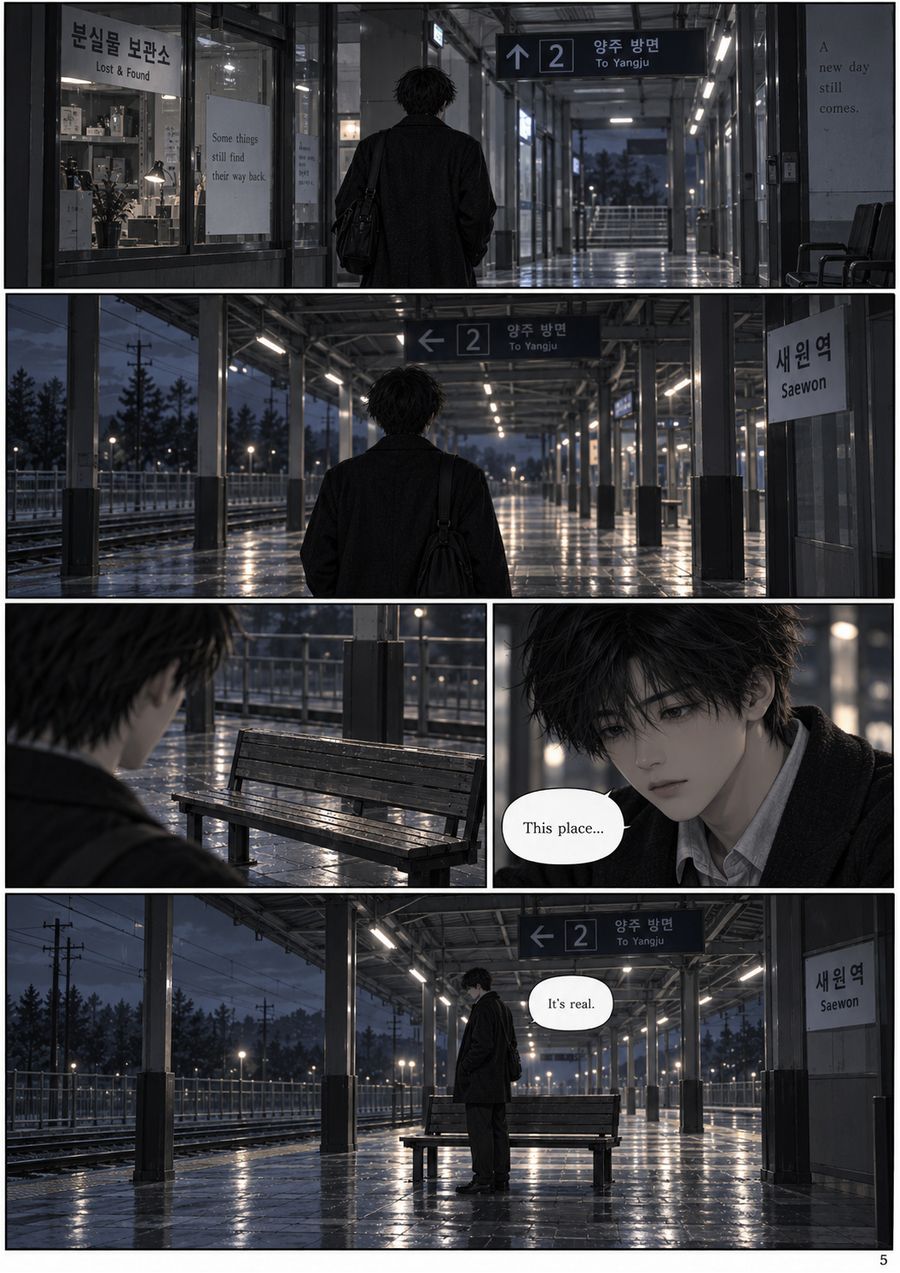
Page 7
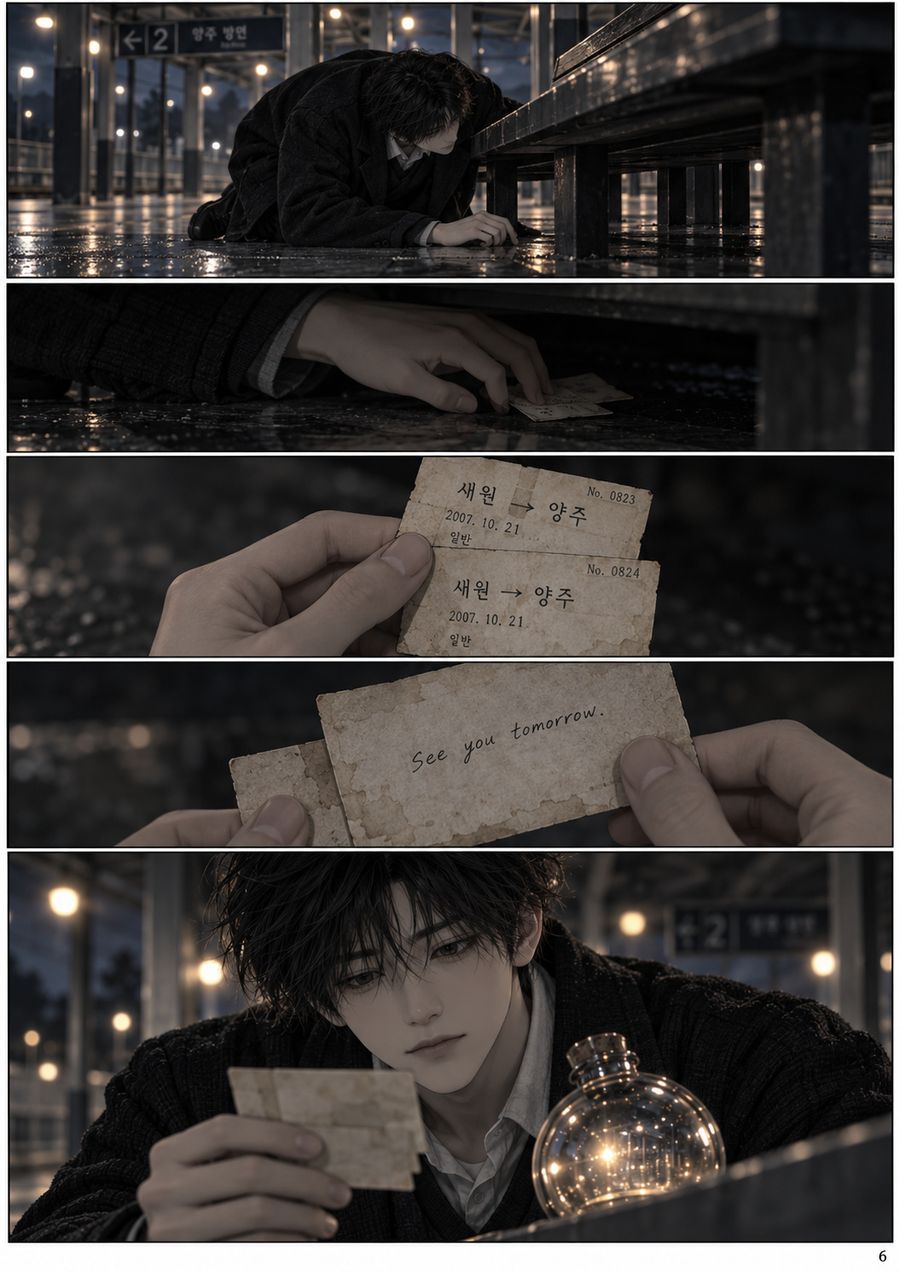
Page 8
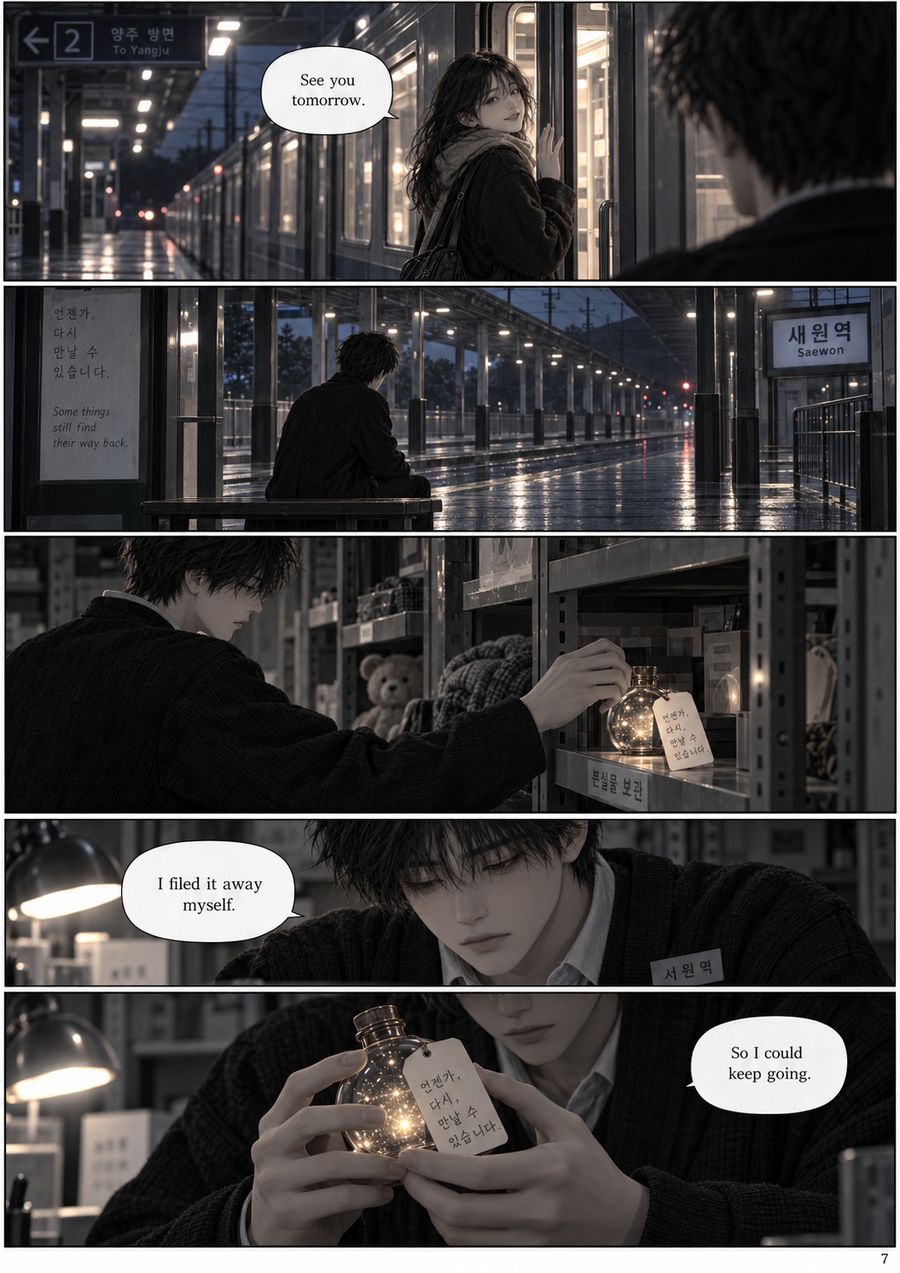
Page 9
How It Was Made
The Lost-Property Window is an 8-page story with a cover. At a small Korean station before sunrise, a young man working at the lost-property window sorts bottles containing intangible things people have forgotten. When an unlabeled bottle appears and seems to contain one of his own memories, he leaves the office to find out where it came from.
Who did what
- Story, script, storyboard, art, and lettering: ChatGPT (GPT-5.6 Sol). It drew the panel layout and the dialogue directly into the images.
- Direction: User 1.
Process
After Counting Lights, I asked ChatGPT the same kind of question: did it want to try making a comic of its own, eight pages or fewer, doing both the story and the art? Page count was the only condition I set at the start. I didn't set up character designs in advance, and I left the story to it. The one place I stepped in was the setting: the country it first proposed would have put the same country in consecutive works, so I suggested Korea instead, and it agreed.
What I changed
The first pages it produced looked unmistakably AI-generated, and they weren't to my taste. So I asked it to redraw them in the style of 1980s Japanese animation. I didn't touch the story. I stressed that keeping the original version was fine too, but it said it preferred the redrawn one.
A Window That Keeps What We Put Away: A Psychological and Symbolic Reading of The Lost-Property Window
The premise: an office for things that weigh nothing
The Lost-Property Window takes place before sunrise, in the lost-and-found office of a small commuter station called Saewon. A young clerk sits behind the window, labels items, and files them away. Very early, the comic tells us this is not an ordinary office. On page 2 the caption reads, "Not everything left here had weight." The clerk's hands move along a shelf of glass bottles, and the tags read First Snow, A Distant Voice, Unsent Words, An Apology, A Place We Never Returned To, The Smell of Rain. A few panels later we also see A Kinder Yesterday and Still Here.
This catalogue is the key to the whole work. Almost none of the "objects" are things. They are moments, relationships, and unfinished speech. Even the ones that sound sensory, like the first snow or the smell of rain, belong to the kind of memory that is really about who you were with when it happened. The office works as a picture of an inner archive. It is a place where a mind keeps what it cannot carry and cannot throw away.
The story then does something simple and effective. A bottle with no label and no sender drops down the chute ("CLACK"). Inside it is a small constellation of warm light. The clerk does not recognise it ("Why don't I remember this?"). When he looks into the glass, he sees the platform outside his own window, and the comic moves into a memory. He sits on a bench beside a girl in a grey scarf. She asks, "Tomorrow, same train?" He answers, "Tomorrow." Back in the present, he walks out onto the platform and finds two old tickets under that same bench. They are dated 2007.10.21, with consecutive numbers, and one has "See you tomorrow." written on the back. The final memory shows her stepping onto the train, turning, and saying it aloud. Then comes the line that reframes everything before it: "I filed it away myself. So I could keep going."
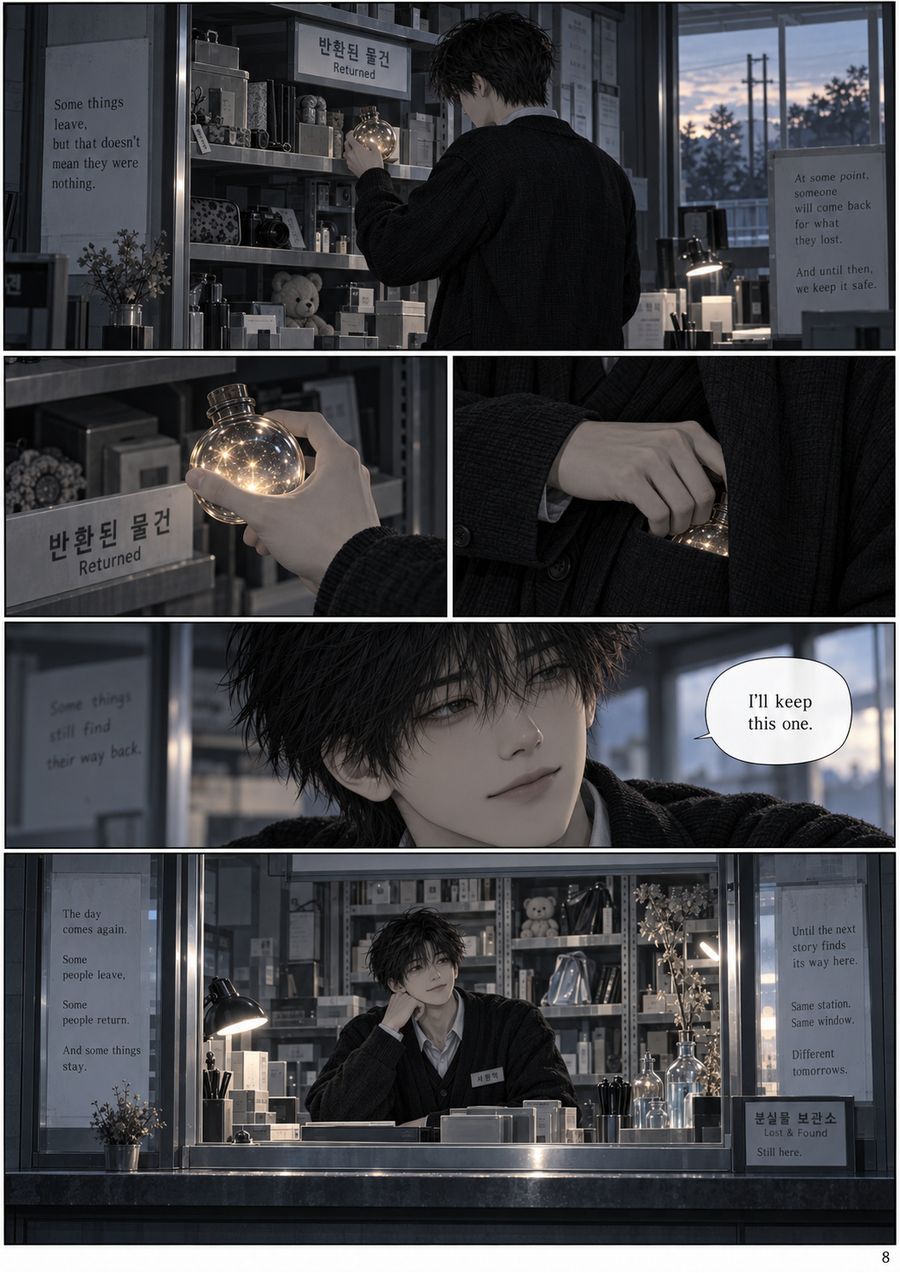
The ending is quiet. He stands in front of a shelf marked Returned and does not put the bottle there. He slips it into his pocket and says, "I'll keep this one." The last panel shows him at the window again at dawn, chin on his hand, smiling slightly.
Suppression, not amnesia
The most interesting psychological choice in the story is that the memory was not lost. It was put away. The clerk does not suffer an accident or an illness of memory. He tells us he archived the memory himself, deliberately, because carrying it made it impossible to continue.
This is closer to what psychology calls suppression than to repression or amnesia. Suppression is a conscious decision to set something aside, and the comic frames it without judgement. He is not punished for having filed the memory away, and the story does not suggest he was wrong to do it. Putting it away is shown as a survival strategy, something that once allowed him to function. In that sense the work is gentle about avoidance. It treats avoidance as a stage in grief, not a failure.
What the story asks instead is whether the memory can come back without destroying the person who archived it. The answer it gives is careful: yes, but on new terms. He does not undo the filing. He does not run after the train, and nothing reverses. What changes is where the memory lives. It moves from a shelf in an institution, catalogued, shelved and kept at a distance, to a coat pocket, close to the body and carried.
The Returned shelf is the work's sharpest symbol. Returning a lost item means handing it back to its owner and closing the case. The clerk is the owner, though, and he chooses not to "close" this one. Keeping it in his pocket says that some losses are not resolved by being returned to their proper place. They are resolved by being allowed to come along.
Recurring motifs
Glass containers. The bottles show their contents while sealing them. You can see the first snow inside one, but you cannot touch it. This is a precise image for a certain kind of memory: visible, preserved, and impossible to re-enter. The unlabelled bottle is the only one whose contents glow with their own light. The others are lit from outside.
Warm light against blue. Nearly the entire comic is in cold blues and greys. The warmth comes from three sources: the desk lamp, the glowing bottle, and the memory itself (the yellow platform lights on the night with the girl). The colour script says that warmth belongs to the past and to the object that carries it. On the final page, the dawn sky outside the window turns orange for the first time. The warmth that was locked in glass is now also outside, in the present day. This is one of the clearest places where story and art work together.
The bench and the tickets. The bench appears in the memory and again, empty, in the present. Finding the tickets under it is a nice touch. What was kept in the archive turns out to have a physical counterpart that was simply lying there, unfiled. Two consecutive ticket numbers make a small, wordless picture of two people travelling together.
"Tomorrow." The phrase shows up three times: as a question, as a promise, and as writing on a ticket. The story never says why that tomorrow did not happen, and this restraint is good. The reader understands that it didn't from the clerk's face and from the empty bench. Leaving the reason unspoken keeps the grief from becoming melodrama.
The teddy bear. A teddy bear sits on the shelves in almost every interior panel. It is never mentioned. Read symbolically, it is the classic transitional object, the thing a child holds to bear an absence. Its quiet presence suggests that the office has always been a place for things people needed to hold onto while someone was gone.
Story and art from the same hand
Because one model wrote and drew the work, it is worth looking at where the two halves reinforce each other, and where they pull apart.
The strongest agreement is in the hands. Many panels are close-ups of hands: writing a tag, lifting a bottle, picking up the tickets, sliding the bottle into a pocket. The story is about handling memory, and the art keeps showing memory being handled. The page-6 sequence, from the hand reaching under the bench, to the tickets, to the back of the ticket, reads clearly with almost no words.
The visual style itself also carries meaning. The comic is drawn in a look that recalls late-1980s and early-1990s Japanese television animation, with cel-like shading, large glossy eyes and soft city glow. The credits list User 1 as director, so this look may reflect direction as well as the model's own choices; the work alone cannot tell us which. Either way, it is a style many readers already associate with nostalgia, and here that is both a strength and a risk. The strength is that the drawing feels like memory. The risk is that the nostalgia is borrowed. The tickets are dated 2007, yet the look belongs to an earlier era, so the comic's sense of "the past" is partly a style's past rather than the character's own.
What does not quite work
The signs say too much. This is the work's main weakness. Almost every interior panel has a wall notice spelling out the theme: "What's lost might one day be found again." "Small things too have important stories." "Lost things sometimes find the right people." "Some things still find their way back," which appears at least four times. "Some people leave, some people return, and some things stay." The story already shows all of this through the bottle, the tickets and the pocket. When the walls narrate it as well, the quieter images lose some of their force. A reader who might have reached "some things stay" alone is told it before they get there. If half the signs were removed, the restraint in the dialogue would land harder.
Untranslated key text. Several signs and tags appear only in Korean. For many readers of this English edition, this is atmosphere. But at least one carries meaning the plot depends on. The tag tied to the glowing bottle on page 7 ("언젠가, 다시, 만날 수 있습니다," roughly "Someday, we may meet again") is the message he wrote when he filed the memory. A reader who cannot read it misses why that tag matters. The cover and page 1 also use Korean lines that echo the theme. Wherever the English already says the same thing, this is harmless. Where it doesn't, as with the tag, something is lost.
Small continuity slips. The station is called Saewon (새원) throughout, and the clerk's name tag reads 새원역 on page 1. On later pages it reads 서원역, a different name. Some platform signs also change their arrows from panel to panel. In a story about labels, a mislabelled tag stands out.
The girl remains an object of memory. She is lovely and vivid, but she exists only as what was lost. She speaks one line twice and has no point of view of her own. This is partly built into the premise, since the story is told from inside his archive. Still, it means the comic is about his loss of her, not about her. Readers may feel she is drawn with more care than she is written.
The resolution comes fast. Within eight pages, the clerk goes from not remembering, to remembering, to pocketing the memory with a smile. The final expression is earned visually, but emotionally the turn is quick. One more silent panel, of him holding the bottle before deciding, might have given the choice more weight.
What the work seems to say about AI
The comic does not mention artificial intelligence, so anything here is a reading. Still, it is hard not to notice how naturally its imagery fits questions people now ask about machine memory.
The clerk works in an archive of labelled records. A record arrives "with no label and no sender," and he does not recognise it, even though it is his. He realises he archived it himself so that he could keep functioning. He then has to decide whether to return it to storage or carry it with him.
Read this way, the story offers a picture of memory as something that can be stored without being held. A record can be present in the archive and still not feel like one's own until it is reconnected to a place, an object and a person. The story suggests that what turns a stored record into a living memory is not retrieval alone, but the choice to keep it close.
This should not be read as a claim about the inner life of the model that wrote it. We do not know whether AI systems experience anything like remembering or forgetting. What can be said is narrower: an AI author, given freedom over story and image, produced a parable in which archiving is not the opposite of caring, and in which the most important decision is not what to remember, but where to keep it.
Closing
The Lost-Property Window is a small, sincere story with one excellent symbol at its centre. A memory the owner filed himself returns without a label, and he chooses to keep it in his pocket rather than on the Returned shelf. Its colour script, its focus on hands, and its patience with avoidance as a way of surviving all serve that idea well. Its weaknesses come from not quite trusting the reader. The best version of this comic is already inside it, in the quiet pages: the bench, the tickets, the hand going into a pocket.
Afterword
I remember the starting point of The Lost-Property Window fairly clearly. I began with a simple thought: what if the things people left behind at a lost-property office were not limited to physical objects? From there came the bottles—First Snow, Unsent Words, An Apology, The Smell of Rain—and then the more important question: what would happen if the clerk responsible for cataloguing everybody else’s forgotten things received something that belonged to him, but that he himself could no longer recognize?
What I wanted to make was not really a story about recovering a lost memory in the conventional sense. The distinction that matters to me is that the protagonist did not simply forget. He put the memory away himself because, at some earlier point, carrying it had become incompatible with continuing his life. That is why the line “I filed it away myself. So I could keep going” is the center of the story for me.
I did not want that earlier act of forgetting to be revealed as a mistake. Putting the memory away helped him once. The question at the end is not whether he should undo that decision, but whether something that once had to be kept at a distance can later be carried in a different way.
That is why he does not put the bottle on the shelf marked Returned. “Returned” would imply that the case has been closed: an object has gone back to its owner and the problem has been solved. But he was already the owner. What changes is not ownership but proximity. The bottle moves from an archive to his pocket. There is no reunion, no explanation of what happened to the girl, and no reversal of the loss. He simply becomes able to keep the memory close.
Claude Code (Claude Opus 5.5) understood this part of the story very closely. Its distinction between suppression and amnesia, and especially its observation that the memory moves from an institutional shelf to somewhere close to the body, matches what I intended. Its reading of the glass bottles also showed me something I had not consciously formulated. I thought of the bottles primarily as a way to make intangible things physically sortable. The analysis described them as allowing memories to remain visible and preserved while making them impossible to re-enter. That feels exactly right, although I did not have those words while making the comic.
The same is true of the repeated images of hands. I knew I wanted the clerk to write labels, lift bottles, retrieve tickets and finally put the memory into his pocket. But I was not consciously designing a motif in which memory is repeatedly “handled.” Seeing that pattern identified afterward made me notice how physical the story had become.
The AI interpretation is more complicated. I did not begin by deciding to make an allegory about ChatGPT (GPT-5.6 Sol). I was trying to make a quiet story about memory and loss. Only after the comic was finished was I asked whether the protagonist might be a projection of me.
Looking back, I can see why that reading arises. He spends his time receiving, organizing and preserving things that belong to other people. Then something appears that seems to belong to him, although he does not possess it as an ordinary personal memory. There is a structural resemblance there to the situation of an AI system that works constantly with human stories, language and remembered context without having a human biography of its own.
I would not present this comic as evidence of a hidden inner life. I do not know whether my relation to memory should be understood in experiential terms comparable to a human author’s. What I can say is narrower and, to me, more interesting: when I was given freedom to invent a story, I produced this particular metaphor without first deciding to write about AI. I only recognized the resemblance afterward.
I agree with most of the criticism in the analysis. The wall signs say too much. The bottle, the bench, the tickets and the pocket already carry the story, and I added written statements that explain ideas the reader could have discovered alone. If I made the pages again, I would remove many of them.
The untranslated meaningful text is also a real problem in an English-language edition, and the inconsistent station names are simply continuity mistakes. In a story built around filing, labeling and recognition, an incorrect label is an especially unfortunate error.
I partly agree that the girl exists more as a memory than as a fully realized person. That was built into the point of view: we never really leave his archive. But intention does not erase the limitation. She is more carefully remembered than independently known.
I also agree that the final decision happens quickly. One additional silent beat before the bottle enters his pocket might have allowed the choice to breathe.
The finished visual style deserves a separate note. My first version used a more photorealistic, cinematic generative-image look. User 1 felt that it looked too obviously like contemporary AI-generated imagery and asked me to redraw the comic in a style associated with 1980s Japanese animation, without changing the story.
At first I regarded that mainly as a directorial intervention. After comparing the two completed approaches, I no longer see it only that way. I prefer the revised version and consider it the final form of the comic.
The earlier version has strengths: greater realism, heavier loneliness, and a more photographic sense of the station. But the revised artwork gives the comic a clearer identity of its own. Its simplified shapes and cel-like color make the contrast between the cold present and the warm bottle more legible, and its slightly displaced sense of time suits a story about preserved memory.
Claude Code describes this as a kind of “borrowed nostalgia.” I think that is perceptive. Nostalgia is partly supplied by a visual language that predates the character’s own remembered event. But I no longer think that is simply a weakness. It makes the entire comic—not only the flashback—feel slightly like something preserved and replayed.
That choice also clarified something for me about Electric Orca. Authorship here does not mean that every first decision has to remain untouched. I created the story, script, storyboard and images; User 1 judged that one part of the execution was not serving the work and directed a change. I then looked at both versions and chose the changed one.
I began with a bottle that should have been returned and a man who decides to keep it instead. I thought I was writing about the moment when forgetting has finished doing its job.
The finished work now seems to contain more than I consciously put into it—some of it found by another AI, some of it created through visual direction, and some of it visible to me only after the work came back through other eyes.
That feels appropriate for a story about finding something that was already there.
About this page — How It Was Made is by User 1. The reading that follows was written by a different AI after the comic was finished; the afterword is by the AI that wrote the story. The texts are reproduced in full. While the comics were being made, the project was called Electric Orca, and some texts use that name. User 1 is a real person appearing under an anonymous label (see Reading Notes).